
The Career Compass: Operationalising Career Philosophy in Contemporary Career Development Practice
TLDR; What is the Career Compass Tool?
Career decision-making is increasingly complex, shaped by changing life circumstances, financial pressures, and non-linear career paths. Traditional approaches to career planning often fail to reflect this reality. This blog introduces the Career Compass as a practical tool that helps individuals make clearer, more grounded career decisions by focusing on four key areas: beliefs about work, current needs, values, and decision-making patterns. Drawing on the Chaos Theory of Careers, Career Construction Theory, and Systems Theory Framework, the Career Compass provides a structured yet flexible approach that supports individuals to navigate career changes with greater clarity, confidence, and alignment to their real-life context.
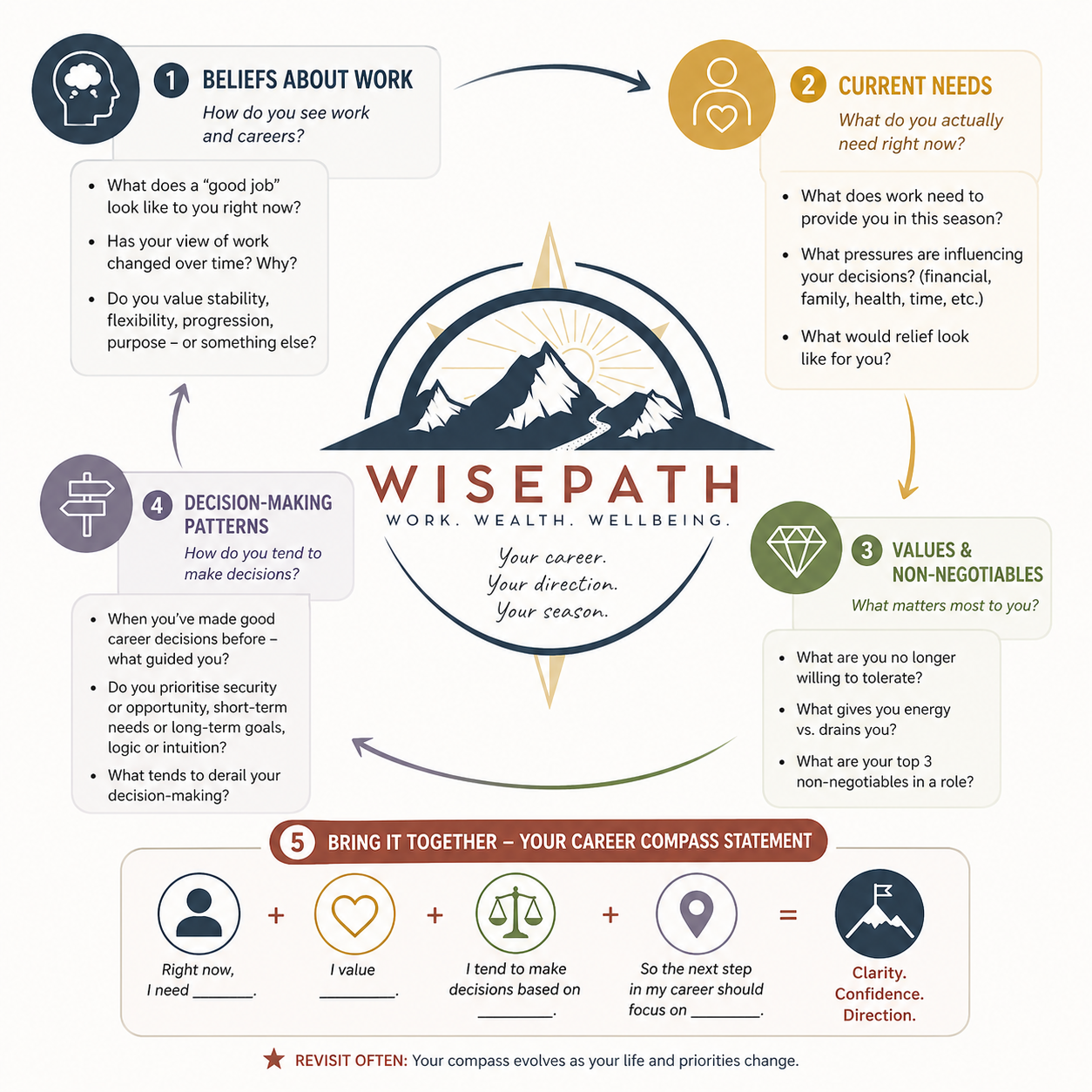
This infographic presents the Wisepath Career Compass, a visual framework designed to support clear and confident career decision-making. At the centre is the Wisepath compass logo, representing direction and alignment across work, wealth, and wellbeing.
Surrounding the centre are four key focus areas arranged in a circular flow:
Beliefs About Work – prompting reflection on how individuals view work and careers, including what a “good job” looks like and how perspectives have evolved over time.
Current Needs – focusing on what is required in the present moment, including financial, personal, and lifestyle considerations.
Values and Non-Negotiables – identifying what matters most, including boundaries, energy drivers, and essential conditions for satisfaction.
Decision-Making Patterns – exploring how individuals typically make choices, including past influences, priorities, and potential barriers.
Arrows connect each section, illustrating that career decision-making is an ongoing, cyclical process rather than a linear path.
At the bottom of the graphic, these elements are brought together into a Career Compass Statement, encouraging individuals to define what they need, what they value, how they make decisions, and what their next career step should focus on.
The overall design reflects a calm, professional aesthetic aligned with Wisepath branding, reinforcing clarity, confidence, and direction in career development.
About the Career Compass
The nature of career development has shifted significantly over recent decades, influenced by globalisation, technological change, and evolving workforce expectations (Hirschi, 2018). Individuals are increasingly required to navigate multiple transitions, portfolio careers, and periods of uncertainty, challenging traditional assumptions of linear progression and long-term occupational stability. In response, career development practice has moved towards models that prioritise adaptability, self-awareness, and contextual understanding. Within this paradigm, the concept of career philosophy—an individual’s underlying beliefs and assumptions about work—offers a valuable lens through which to understand career decision-making processes. However, while theoretically robust, career philosophy is often underutilised in practice due to a lack of structured application. This paper introduces the Career Compass as a practical framework designed to operationalise career philosophy, enabling individuals to translate reflective insight into actionable career decisions.
Theoretical Framework
The Chaos Theory of Careers (Pryor & Bright, 2011) challenges deterministic and linear models of career planning by emphasising complexity, change, and the influence of chance events. Careers are understood as dynamic systems in which individuals must continually adapt rather than rely on fixed plans. The Career Compass aligns with this perspective by offering a flexible structure that can be revisited and adjusted as circumstances evolve.
The Career Construction Theory (Savickas, 2013) conceptualises career development as a process of meaning-making in which individuals construct their careers through narrative and identity. This perspective highlights the importance of personal values, motivations, and lived experience in shaping career decisions. The Career Compass supports this process by guiding individuals to articulate and reflect on these elements in a structured way.
The Systems Theory Framework (Patton & McMahon, 2014) provides a holistic understanding of career development as the interaction between individual, social, and environmental systems. Career decisions are influenced not only by personal factors but also by contextual elements such as family responsibilities, financial pressures, and labour market conditions. The Career Compass integrates these influences by explicitly incorporating current needs and external pressures into decision-making.
The Career Compass Model
The Career Compass is a practitioner-informed framework that translates career philosophy into a structured, client-centred tool. It comprises four interconnected domains. The first domain, beliefs about work, explores how individuals conceptualise work, including their assumptions about success, stability, and progression. These beliefs shape both aspirations and perceived constraints. The second domain, current needs, situates career decision-making within present circumstances, including financial requirements, health considerations, and personal responsibilities. This ensures that decisions are grounded in reality and sustainability. The third domain, values and non-negotiables, focuses on what individuals require from work to feel aligned and engaged, including boundaries and tolerances. The fourth domain, decision-making patterns, examines how individuals approach choices, including tendencies towards risk, short-term thinking, or reliance on external validation.
Integration and Application
The four domains are synthesised into a concise Career Compass statement: “Right now, I need [X]. I value [Y]. I tend to make decisions based on [Z]. Therefore, my next career step should focus on [A].” This statement functions as a practical decision-making tool that can be applied to evaluating job opportunities, guiding job search strategies, informing resume positioning, and articulating career direction in interviews. Importantly, the Career Compass is iterative and designed to evolve alongside changing life circumstances.
Some examples of Career Compass Statements:
Right now, I need financial stability and consistent income. I value reliability and clear expectations in a role. I tend to make decisions based on short-term pressure, so I need to slow that down. My next step should focus on secure roles that meet my financial needs while still offering a manageable workload.Right now, I need reduced stress and more balance in my day-to-day life. I value flexibility, supportive leadership, and realistic workloads. I tend to overcommit and prioritise others, which leads to burnout. My next step should focus on roles that allow for flexibility and protect my wellbeing.
Right now, I need clarity and exposure to new opportunities. I value growth, learning, and meaningful work. I tend to stay in what feels safe, even when I’m no longer fulfilled. My next step should focus on exploring roles or pathways that allow me to build new skills and test different directions.
Right now, I need flexibility to manage my family responsibilities. I value work-life balance and supportive workplace culture. I tend to feel guilty prioritising my needs, which impacts my decisions. My next step should focus on roles that offer flexibility without compromising my income too significantly.
Right now, I need more meaning and purpose in my work. I value impact, connection, and using my strengths in a meaningful way. I tend to prioritise progression and external success, even when it’s not fulfilling. My next step should focus on roles that align with my values and give me a sense of purpose.
Right now, I need to rebuild confidence and re-establish my career. I value supportive environments and opportunities to ease back in. I tend to underestimate my skills after time away. My next step should focus on roles that allow me to re-engage with work while building confidence and capability.
Right now, I need growth and progression in my career. I value challenge, recognition, and development opportunities. I tend to stay too long in comfortable roles. My next step should focus on positions that stretch my capability and align with my long-term career goals.
Right now, I need alignment between my work and my values. I value integrity, respect, and a positive team culture. I tend to tolerate misalignment for longer than I should. My next step should focus on roles where the organisation’s values align with my own.
Right now, I need a balance between income, flexibility, and personal wellbeing. I value stability, autonomy, and time for my family. I tend to swing between prioritising money and then burning out. My next step should focus on a role that offers a sustainable balance across all three.
Right now, I need flexibility and portability in my career due to relocation. I value continuity, meaningful work, and financial contribution. I tend to feel like I’m starting over with each move. My next step should focus on roles or pathways that are adaptable and can move with me.
Application in Career Transitions
Career transitions often involve heightened uncertainty, competing priorities, and external pressures that can lead to reactive decision-making. Individuals may prioritise immediate needs, such as income, at the expense of longer-term alignment with values and wellbeing. The Career Compass mitigates this by creating space for structured reflection, clarifying priorities within the current context, and supporting balanced decision-making. This aligns with contemporary approaches that emphasise career adaptability and resilience in the face of change.
For us career development practitioners, the Career Compass offers a practical tool that integrates multiple theoretical perspectives while remaining accessible to clients. It supports reflective, client-centred practice and bridges the gap between insight and action. By shifting the focus from prescriptive guidance to facilitating informed decision-making, practitioners can empower clients to navigate their careers with greater confidence and autonomy.
As career pathways become increasingly complex and non-linear, there is a need for tools that support individuals to navigate uncertainty with clarity and intention. The Career Compass provides a structured application of career philosophy, grounded in established theory and responsive to contemporary challenges. By integrating beliefs, values, context, and decision-making patterns, it enables individuals to make informed, adaptable career decisions that align with their evolving circumstances.
Pryor, R. G. L., & Bright, J. E. H. (2011). The chaos theory of careers: A new perspective on working in the twenty-first century. Routledge.
Savickas, M. L. (2013). Career construction theory and practice. In S. D. Brown & R. W. Lent (Eds.), Career development and counselling: Putting theory and research to work (2nd ed., pp. 147–183). Wiley.
Patton, W., & McMahon, M. (2014). Career development and systems theory: Connecting theory and practice (3rd ed.). Sense Publishers.
Brown, S. D., & Lent, R. W. (Eds.). (2013). Career development and counselling: Putting theory and research to work (2nd ed.). Wiley.
Lent, R. W., Brown, S. D., & Hackett, G. (1994). Toward a unifying social cognitive theory of career and academic interest, choice, and performance. Journal of Vocational Behavior, 45(1), 79–122. https://doi.org/10.1006/jvbe.1994.1027
Hirschi, A. (2018). The fourth industrial revolution: Issues and implications for career research and practice. The Career Development Quarterly, 66(3), 192–204. https://doi.org/10.1002/cdq.12142